How to Start Strength Training at Home With One Pair of Adjustable Dumbbells
You do not need a room full of equipment to begin strength training. One pair of adjustable dumbbells can cover a squat, hinge, push, pull, carry, and core exercise—the main movement patterns needed for a practical full-body routine. The harder part is choosing manageable loads, changing them safely, and progressing without turning the first week into a test of willpower.
Federal physical activity guidance recommends muscle-strengthening activity for all major muscle groups on at least two days each week. That is a destination, not a demand to begin with a perfect program. If you are inactive, returning after surgery or injury, pregnant, or managing a condition that affects exercise, ask an appropriate health professional how to adapt the plan.
Prepare the space and learn the dumbbells
Clear enough floor space to step backward and lower a weight without striking furniture, pets, or another person. Wear stable footwear if you need traction; a mat is optional, not a substitute for a firm surface during standing exercises.
Before lifting, learn the selector mechanism with the dumbbells in their base. Confirm that both selectors show the same load and are fully engaged. Lift the handle a few inches and check that only the intended plates rise. Never move a selector while the dumbbell is out of its base, and follow the manufacturer’s instructions rather than improvising a partial setting.
The PowerBlock Sport 24 is sold as a pair and adjusts from 3 to 24 pounds per hand in 3-pound increments. The magnetic polypropylene selector and compact nested design make load changes quick between exercises. The model is not expandable beyond 24 pounds, so it is best suited to beginners, lighter accessory work, and households that value compact storage. A stronger lifter may outgrow it for squats, rows, or deadlift variations.
Choose a starting weight by repetition quality
The correct first weight is the one you can control through the intended range without holding your breath, rushing, or changing position to finish. Use this test:
- Select the lightest plausible load.
- Perform five slow practice repetitions.
- Continue only while the movement remains steady and pain-free.
- Stop with several good repetitions still available rather than reaching failure.
Different exercises need different loads. A squat or suitcase deadlift may use more weight than a shoulder press or reverse fly. Adjustable dumbbells are valuable precisely because one number does not have to serve every movement.
Alternate two full-body sessions
For the first week, complete one set of each exercise in Session A, rest at least a day, and complete one set of Session B. Repeat that schedule in week two only if ordinary muscle soreness resolves and daily activities feel normal. Then add a second set to one or two movements at a time. For the strength exercises, aim for 8 to 12 controlled repetitions as a practical starting range. For the suitcase carry, walk a short distance while you can maintain good posture.
Session A
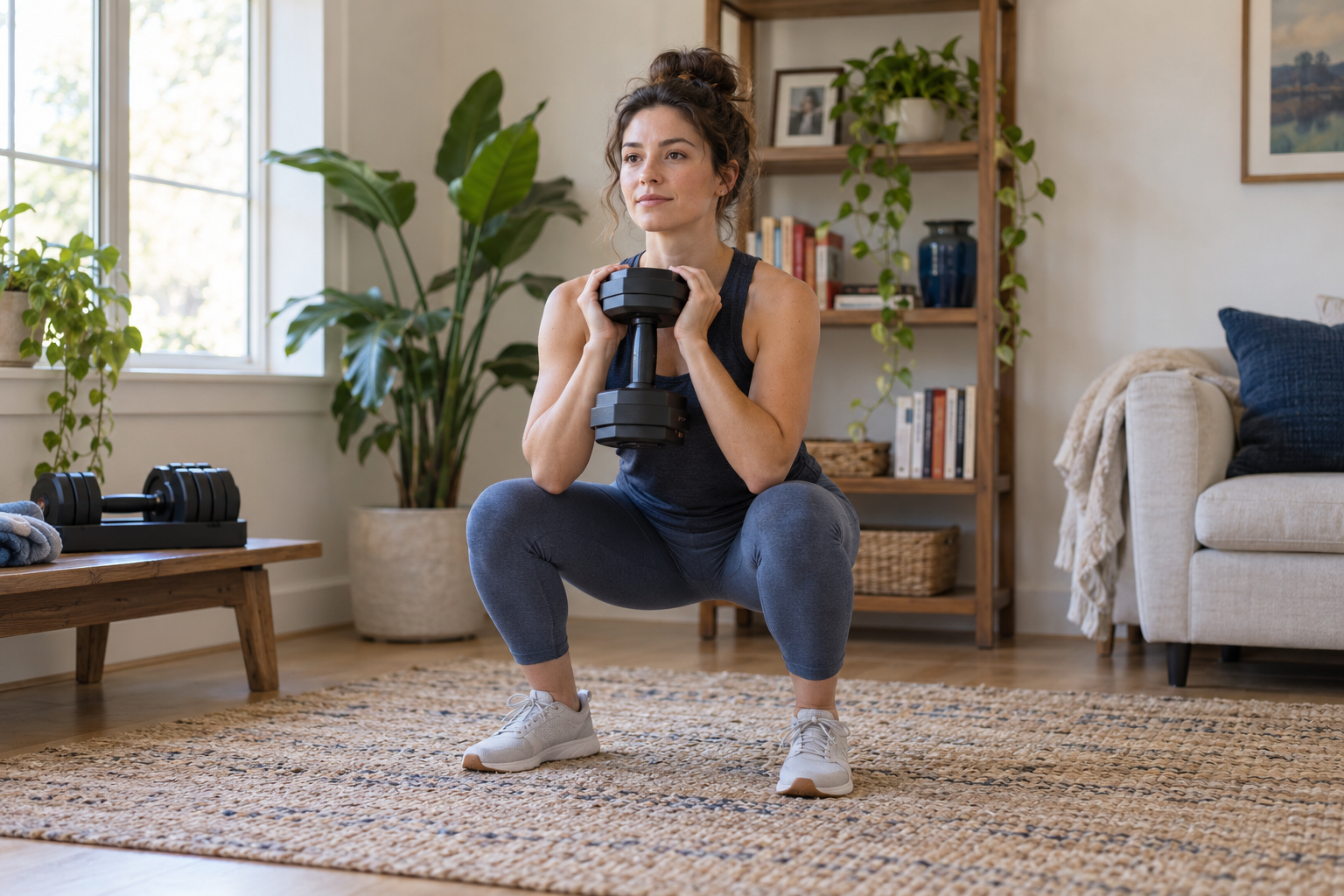
- Goblet squat: Hold one dumbbell vertically at the chest. Sit between the hips while keeping the whole foot supported, then stand.
- Floor press: Lie on the floor with knees bent. Press the dumbbells upward and lower until the upper arms gently contact the floor.
- Supported one-arm row: Place the free hand on a sturdy chair or bench and pull the dumbbell toward the hip without twisting.
- Suitcase carry: Walk slowly with one dumbbell at your side, staying tall; switch hands halfway.
Session B
- Romanian deadlift: Hold the weights in front of the thighs, soften the knees, push the hips back, and stop before the back loses its neutral position.
- Half-kneeling or standing press: Press one dumbbell overhead only through a comfortable range, without leaning backward.
- Split squat to support: Hold a stable surface with the free hand and lower only as far as you can control.
- Dead bug without weight or with one light dumbbell: Keep the lower back comfortably supported and move opposite limbs slowly.
Leave at least a day between these sessions at first. A five-minute warm-up can include easy marching, sit-to-stands, shoulder circles, and unloaded practice repetitions. Stop for sharp pain, chest pain, faintness, or unusual shortness of breath.
Progress one variable at a time
Keep a short record of exercise, weight, repetitions, and how the final repetition looked. When you can complete the top of your chosen repetition range with the same control across two sessions, choose one progression:
- Add one or two repetitions while keeping the weight.
- Add a second set.
- Move to the next 3-pound increment and return to fewer repetitions.
- Use a slightly greater comfortable range of motion.
Do not increase all four at once. The Sport 24’s 3-pound jumps are modest for lower-body exercises but can feel large for smaller shoulder or arm movements. If the next increment disrupts form, stay at the lighter setting and progress with repetitions, tempo, or an additional set.
Make the routine easy to repeat
Store the dumbbells in their bases on a dry, level surface away from walkways. Put the two sessions on specific days that usually have enough time, but keep a minimum version for difficult weeks: one set of a squat, a press, a row, and a carry. A shorter controlled session still reinforces the routine.
Buy adjustable dumbbells when compact storage and rapid load changes solve a real problem. If you already own suitable weights, begin with them. Before choosing the Sport 24, compare its 24-pound-per-hand ceiling with a weight you can presently carry or row with control at a gym, store, or supervised session. If that ceiling already feels comfortable for many repetitions on your strongest movement, choose a heavier expandable system rather than buying twice. Do not perform an unfamiliar maximal lift simply to make this decision.